Edits: Video Editor
- 4.7
- Rating
- 100.00M
- Installs
- Free
- Price

 Analysis by App-foxy
I approached Edits: Video Editor as the kind of tool I would keep on my phone for quick social videos rather than as a replacement for a full desktop editing suite. It is a free video editing app from Instagram, aimed at people who want to turn clips into something publishable without moving between several different applications. After spending time with its workflow, I found that its biggest appeal is not simply trimming footage. It is the way it keeps the basic process close to the habits of people who already create short-form content: gather clips, shape the timing, add a little polish, and prepare the result for sharing.
The app sits in the video players and editors category, but that label does not quite explain its practical character. I see it as a focused creation workspace for mobile users who want less friction between an idea and a finished video. The developer is Instagram, and that connection gives the app a clear audience, even if you do not publish every project on Instagram. If you regularly record food, travel, family moments, product demonstrations, fitness routines, or short talking clips, the editing process feels more approachable than opening a complex desktop program.
Its listing shows a 4.6 average from around 542 thousand ratings, with more than 2.7 thousand written reviews and over 10 million installs. Those figures suggest that it has already attracted a substantial audience, but I would not choose it solely because of popularity. The more useful question is whether its straightforward approach matches the way you work. In my experience, it does that best when the final video is short, visually clear, and intended for a phone-first audience.
You May Also Like

 AccuWeather: Weather Radar
AccuWeather Review: A Quick, Clear Forecast for Everyday Decisions
For everyday plans, the best forecast is the one you can understand quickly. AccuWeather makes rain timing, radar, and local conditions easy to act on, with a few trade-offs.

 Hill Climb Racing
Why Hill Climb Racing Still Turns Crashes Into One More Run
A tiny car, a bumpy hill and one more upgrade: Hill Climb Racing keeps resurfacing because its simple chaos makes every near-miss feel personal.

 AliExpress - Shopping App
AliExpress Makes Global Shopping Feel Personal, but Shoppers Bear the Risk
AliExpress turns a global marketplace into a pocket-sized discovery engine. Its reach is useful, its shopping loop compelling, and its trade-offs easy to miss.

 Lords Mobile: Kingdom Wars
Lords Mobile Is a Kingdom-Building Routine, Not a Quick Match
A case-by-case verdict on the building, battles, device demands, and social commitments that make Lords Mobile rewarding for some players and exhausting for others.

 PDF Scanner app - TapScanner
TapScanner Makes Paperwork Easier to Capture, Check, and Share
TapScanner makes scanning with a phone feel less like a rescue operation and more like a dependable step in getting work done. Its capture tools are useful, though not flawless.

 Block Blast!
 Shows How Much a Puzzle Game Can Leave Out
A quiet grid game shows why puzzle players increasingly value instant clarity, repeatable skill and low-pressure play—and where the genre still needs to catch up.
More From Our News Desk
View All News


Starting with a repeatable mobile workflow
When I want a mobile edit to feel repeatable rather than improvised, I start by deciding what the viewer should understand before I choose clips. In this section, I’ll focus on a small set of checks that can make the first pass easier to recover when footage or timing doesn’t cooperate. That foundation also makes it simpler to build a quicker routine for projects I make often.
Importing clips with a purpose
The easiest way to get good results in Edits is to begin before opening the editor. I first decide what the video is supposed to communicate, then select only the clips that support that idea. This sounds obvious, but it makes a noticeable difference on a phone. Bringing in every possible recording creates a crowded timeline and encourages me to keep weak footage simply because it is already there.
For a small everyday project, my baseline workflow is simple. I choose an opening clip that explains the subject quickly, place the most useful supporting shots after it, and save the final moment for a clear finish. That structure works for a short café review, a walk through a local market, or a quick demonstration of how I use a household item. I am not trying to tell an entire story with every detail; I am giving the viewer a reason to continue watching and then ending before the idea becomes repetitive.
Edits is particularly comfortable for this kind of selection-based work. I can think in terms of moments instead of treating the project like a film production. A close-up, a wider view, a reaction, and a final result may be enough. The app becomes more useful when I make those decisions first, because its convenience can otherwise tempt me to edit without a clear destination.
Making the first cut before adding decoration
I recommend completing a rough cut before touching text, effects, or music. This is one of the most valuable habits I developed with the app. I remove pauses, accidental camera movement, repeated explanations, and clips that look attractive but do not move the story forward. Only after the sequence feels understandable do I add visual details.
That order matters because decorative editing can hide structural problems for a while. A transition may make two clips feel connected, but it cannot fix an opening that takes too long to explain itself. A sound choice may create energy, but it cannot rescue footage that has no clear purpose. Edits makes quick experimentation easy, so I use that flexibility after the essential decisions are already settled.
For a realistic daily example, imagine recording a short recipe after work. I might begin with the finished dish, cut to two preparation steps, show the key technique, and end with the result again. I would keep the explanation brief, use text only where a viewer might otherwise miss an ingredient or action, and review the complete sequence without sound before exporting. That silent check often reveals whether the images communicate on their own.
Keeping the viewer’s attention without over-editing
Short videos do not need a new effect in every second. I get better results by changing the visual information at sensible moments: moving from a wide shot to a detail, cutting when an action finishes, or using a reaction to break up a sequence of similar images. This approach is faster than decorating every clip and usually feels more natural.
One useful technique is to create a clean version first and then duplicate the editing idea manually for another variation. For example, I might make one cut that begins with the result and another that begins with the problem being solved. Comparing those openings tells me more than endlessly adjusting filters. The app is well suited to this kind of quick testing because the project stays close to the material I recorded.
Settings I check before I begin
Before editing, I check the project orientation and make sure the clips I want to use fit the intended viewing format. Vertical footage is usually the natural choice for phone-first publishing, while horizontal material may need more careful framing. I avoid leaving this decision until the end, because cropping a face, a product, or an important action can force me to rebuild the sequence.
I also review the original recordings for differences in brightness and sound. A phone may capture one clip in a bright window and the next in a darker room. Even if the app offers ways to improve the appearance, a consistent source selection is still the better starting point. I would rather remove one badly matched clip than spend time trying to make every shot look identical.
Another setting worth checking is the audio balance. If I am speaking, music should support the voice rather than compete with it. If the video depends on natural sound, I keep that sound present and avoid covering it with a loud track. This is an area where experienced editing is less about finding a special control and more about listening carefully before finishing.
Export decisions and the final review
I always watch the complete edit once before sharing it. I look for text that appears too briefly, cuts that happen before an action is understandable, and moments where the image changes more dramatically than the sound. I also check the beginning and end separately. The first seconds should establish the subject, and the last seconds should not feel like the recording simply stopped.
Edits is free, which removes one common barrier for casual creators. The content rating is Everyone, and the minimum operating system is 9, so it is accessible to a broad range of compatible phone users. The current version is 410.0.0.62.71. I would still keep enough free storage for source clips and finished exports, because video projects can become inconvenient when the phone is nearly full, regardless of which editor I use.
One practical habit is to avoid exporting several near-identical versions without a reason. I name or organize the source material before starting, make a deliberate change when testing an alternative, and keep the version I actually intend to publish. This reduces confusion later, especially when a project includes multiple openings or different lengths.
Faster patterns for people who edit often
Once the basic sequence is dependable, I look for ways to reduce repeated decisions without making every video feel identical. I’ll cover how I sort footage, separate editing tasks, and use a consistent structure while still adapting it to the subject. Those habits are most useful when I’m making several short videos and want each one to feel deliberate, not rushed.
Use a fixed sequence instead of reinventing every project
When I edit repeatedly, I rely on a small pattern: hook, context, proof, and finish. The hook can be the result, a surprising detail, or a direct question. Context tells the viewer what they are seeing. Proof demonstrates the main point. The finish gives the video a natural stopping place. This is not a rigid template, but it prevents me from staring at a blank timeline every time I open the app.
For a travel clip, the hook might be an unusual view, followed by a location cue, a few details, and a final wide shot. For a product demonstration, the hook can show the problem, followed by the setup, the action, and the result. For a personal update, the strongest moment may be a short spoken line followed by supporting footage. Edits works best when I bring this structure with me instead of expecting the editor to create the idea.
Build a selection routine for busy days
On days when I have little time, I sort footage by asking three questions. Does this clip explain something? Does it add a different view? Does it create a feeling that the other clips cannot provide? If the answer is no to all three, I leave it out. This is a more reliable shortcut than trying to shorten every recording by a tiny amount.
I also edit in passes. The first pass removes unusable material. The second improves order and timing. The third handles text, sound, and visual consistency. Separating those jobs keeps me from making a polished version of a weak sequence. It also makes the app feel faster because every action has a clear purpose.
Make text readable before making it stylish
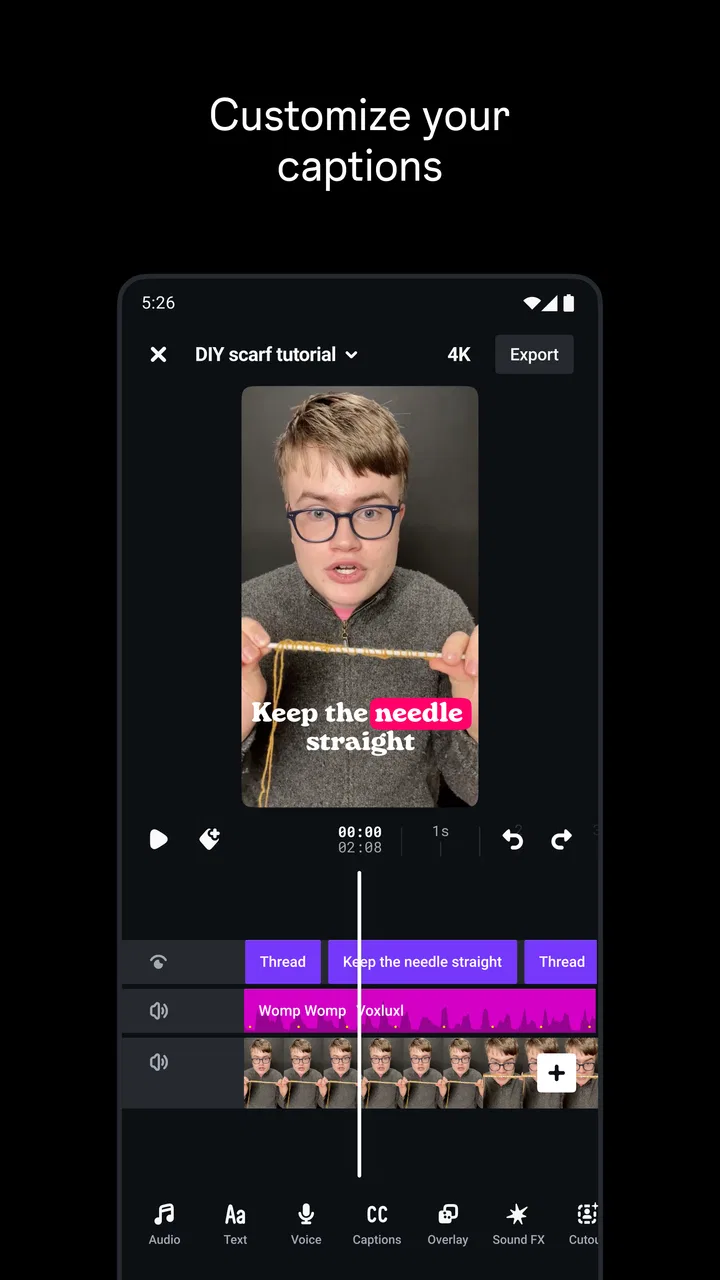
Text can help viewers understand a video when they are watching without sound, but it needs enough time and contrast to be useful. I keep captions short, place them away from important faces or objects, and read them at normal phone distance. If I have to pause to understand a sentence, it is probably too long for the screen.
A non-obvious trade-off is that adding more text may make the video less accessible visually, even when the words are accurate. I often use one concise phrase for the main idea and let the footage carry the rest. For instructional clips, I divide a complicated explanation into separate moments rather than placing a paragraph over one shot.
Choose music after the rhythm is stable
I prefer to settle the cuts before choosing a soundtrack. Otherwise, I may force the footage to follow a beat that does not suit the subject. Once the sequence works silently, music can provide atmosphere and help connect the sections. I then lower it whenever speech or important natural sound appears.
This workflow is especially useful for videos made in noisy places. A street recording may contain valuable ambience but also distracting background noise. I listen to the complete edit with the music removed, decide which natural sounds are worth preserving, and only then balance the other audio. The result is usually calmer than simply placing a loud track over everything.
Where the app saves time compared with usual alternatives
Compared with a full desktop editor, Edits is less intimidating and better suited to quick work away from a computer. I do not need to build a large project with many tracks when I only want a clean social clip. Compared with a basic gallery editor, it gives me a more purposeful space for arranging a sequence and refining the presentation.
That middle position is its strongest practical advantage. A gallery tool may be quicker for one trim, while a professional editor may be better for layered sound, detailed color work, or a long project. Edits makes sense when I need more control than a simple trim but do not want the overhead of a production suite.
Advanced limits I noticed in real use
The same focus that makes the app approachable also defines its limits. I would not choose it for a long documentary, a complex interview with many audio sources, or a project that depends on precise professional color matching. Those jobs benefit from a larger screen, deeper track management, and more detailed control than a phone-centered editor is designed to provide.
I also would not expect a quick mobile editor to replace careful planning for difficult footage. If clips have major exposure differences, unclear speech, or unstable framing, editing can improve the presentation but cannot fully repair the recording. The best results still come from capturing clean source material, leaving room around the subject, and recording more than one usable take when the moment matters.
Another limitation is mental rather than technical: the convenience can encourage me to publish too quickly. Because the path from recording to sharing is short, I have to create my own quality check. Watching without sound, checking the first and last moments, and reading every text element aloud are simple safeguards that prevent avoidable mistakes.
Who should use it and who should skip it
I would recommend Edits to a beginner who wants to make polished short videos without learning a complicated editing system first. It is also a good fit for an experienced social creator who values speed, works mainly from a phone, and prefers a repeatable workflow over endless experimentation. Small businesses, students, travelers, and family creators can all benefit when their projects are brief and visually direct.
I would suggest looking elsewhere if your work depends on detailed audio mixing, elaborate compositing, extensive motion graphics, or a long timeline. A desktop editor will usually be more comfortable for those tasks, and a specialized tool may be preferable when the main goal is advanced sound, animation, or color correction. Edits is not weakened by that distinction; it simply has a more focused job.
My final view after building a habit around it
What I like most is that Edits rewards discipline. It does not require me to turn every clip into a showcase of effects. When I select stronger footage, cut with intention, check the framing early, and review the finished sequence carefully, the app helps me move from idea to shareable video with little wasted effort.
The app is free, rated for Everyone, and developed by Instagram, so it is easy to understand why it appeals to creators already comfortable with mobile social video. Its 4.6 average and audience of more than 10 million installs make it a well-established choice rather than an obscure experiment, but my recommendation comes from the workflow itself: it is quick to learn, practical for everyday projects, and flexible enough to support better habits.
My honest verdict is that Edits is best when you want a focused mobile editor, not a miniature film studio. I would use it for a short recipe, a travel sequence, a product demonstration, or a personal update where clear timing matters more than elaborate production. If you keep your source clips organized and follow a few repeatable checks, Edits: Video Editor becomes a dependable part of a phone-based creative routine. If your ambitions require deep multi-track control, I would move to a more advanced alternative instead of fighting the app’s focused design.
FAQs for Edits: Video Editor
01What are the main features of Edits: Video Editor?
Edits: Video Editor offers a range of features including multi-layer editing, transitions, filters, and text overlays. Users can also enjoy advanced options like video stabilization, green screen effects, and audio editing tools. The app supports a variety of video formats and resolutions, making it versatile for different types of projects.
02Is Edits: Video Editor suitable for beginners?
Yes, Edits: Video Editor is designed to be user-friendly, with an intuitive interface that caters to both beginners and experienced editors. It includes tutorials and a help section to guide new users through the basics of video editing, ensuring a smooth learning curve.
03Does Edits: Video Editor support 4K video editing?
Edits: Video Editor does support 4K video editing, allowing users to work with high-resolution footage without compromising on quality. This feature is ideal for users looking to produce professional-grade videos, offering crisp and clear visuals.
04Are there any in-app purchases in Edits: Video Editor?
While Edits: Video Editor is free to download, it offers in-app purchases for additional features and effects. Users can buy premium transitions, filters, and advanced editing tools to enhance their editing capabilities. A subscription option is also available for unlimited access.
05Can I share my edited videos directly from the app?
Yes, Edits: Video Editor allows seamless sharing of videos directly from the app to various social media platforms like Instagram, Facebook, and YouTube. Users can also save videos to their device in multiple formats and resolutions for offline sharing.
Pros
- Intuitive user interface for easy navigation.
- Wide range of editing tools available.
- Supports high-resolution video exports.
- Quick rendering times for edited videos.
- Includes a variety of filters and effects.
Cons
- Limited free version features.
- Occasional in-app advertisements.
- Requires a stable internet connection.
- High storage usage for large projects.
- Some features need premium access.

Edits: Video Editor
Gallery